 GlobeVision
“AdSense-ready” isn’t an official term Google uses, and there’s no single checklist Google publishes that guarantees approval — which is exactly why site owners end up guessing. What we can describe, based on the patterns behind common rejection reasons Google does publish, is the combination of signals that tends to matter.
This isn't a guarantee framework — no one outside Google can offer that. Understanding the underlying signals makes the difference between guessing and actually improving your odds, but it doesn't change who makes the final call.
Content depth, consistently
A single well-written page won’t carry an entire site through review if most other pages are thin. What seems to matter is the pattern across your site: are most pages genuinely informative, or is the site mostly short pages, embedded content, or affiliate links with minimal original writing around them?
This is why “AdSense-ready” is a site-level property more than a page-level one. Fixing your best page doesn’t fix a site where most pages are thin.
A low ad-to-content ratio, even before you have ads
If you’re building a site anticipating AdSense approval, resist the temptation to reserve large, prominent ad placements before you’re even approved. A layout dominated by ad-shaped white space, or a template with placeholder ad units that look overwhelming relative to the actual content, reads poorly even before real ads are added.
Legal and trust pages that actually exist
A Privacy Policy is close to mandatory in practice — both because Google expects it and because it’s genuinely required if you plan to serve ads that rely on cookies or personalization in most jurisdictions. Beyond that, a visible way to contact the site owner, and clarity about who runs the site, contributes to the trust signals a reviewer is implicitly evaluating.
Original content, not aggregated or spun
Content that’s lightly reworded from other sources, auto-generated without meaningful editing, or heavily duplicated across your own pages tends to be the specific pattern behind “low value content” rejections. This doesn’t mean every sentence needs to be groundbreaking — it means the content should genuinely be yours, written for your specific audience, not assembled to fill space.
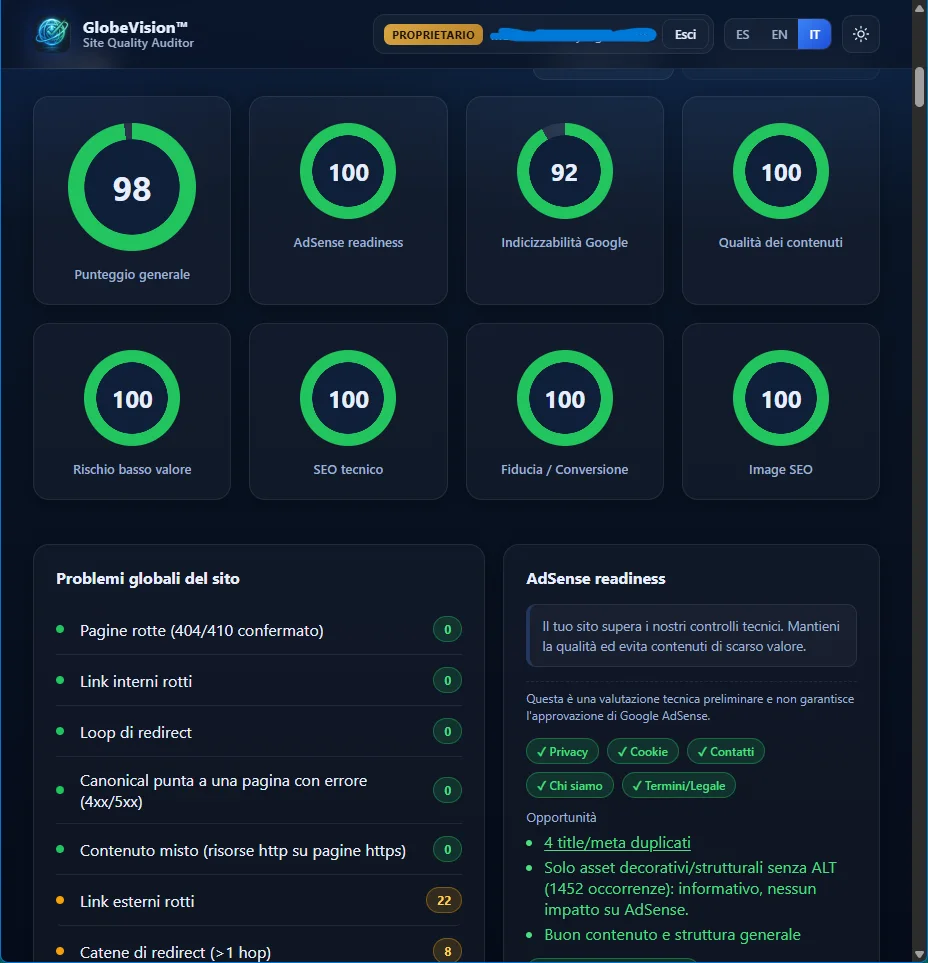
Clean technical health
A site with a significant number of broken links, missing pages, or indexing problems signals neglect — and neglect is hard to distinguish, from the outside, from a site that also has thin or low-quality content. Technical cleanliness doesn’t directly cause AdSense approval, but it removes a category of doubt.
Enough content to be worth reviewing at all
A five-page site with no clear niche is a harder sell than a fifteen-page site with a clear focus, even if the five pages are individually fine. There’s no official minimum, but a site that reads as “barely started” tends to fare worse than one that reads as an established, ongoing project — even a small one.
Key signals to check
- Most pages are genuinely informative, not just the homepage or one flagship article
- Ad space (if any) doesn't dominate the layout relative to actual content
- Privacy Policy and a clear way to contact the site owner both exist
- Content reads as genuinely written for your audience, not lightly reworded or auto-generated
- No significant pile-up of broken links or indexing problems
- The site reads as an ongoing project with a clear focus, not a barely-started placeholder
What GlobeVision checks, and what it can’t tell you
GlobeVision’s AdSense readiness check looks at the technical and content-quality signals described above — thin pages, missing legal pages, broken links, ad-to-content balance where detectable, and the general health signals that correlate with common rejection reasons — across every page of your site, not just the ones you’d think to check by hand.
What it can't do, and what no third-party tool can honestly claim to do, is guarantee Google's decision. Approval is Google's call alone, based on criteria they don't fully publish and can change at any time. What GlobeVision can do is make sure you're not submitting with an obviously fixable problem still sitting on your site.